¶ Electronics
¶ Overview
The STRASSE electronics system is designed to read out ~17000 channels from the silicon tracker with low noise, high speed, and compactness to fit inside the vacuum chamber. The system is triggerless, recording all signals above a threshold and correlating them offline with the RIBF DAQ.
¶ System Architecture
The electronics architecture is divided into 6 detector modules, each containing:
- Silicon Tracker: Inner and outer barrels with DSSDs.
- Front-End Boards (FEBs): Host STS-XYTER ASICs for signal processing.
- Cooling Blades: Dissipate heat from FEBs.
- Microcables: Connect sensors to FEBs.
¶ Block Diagram
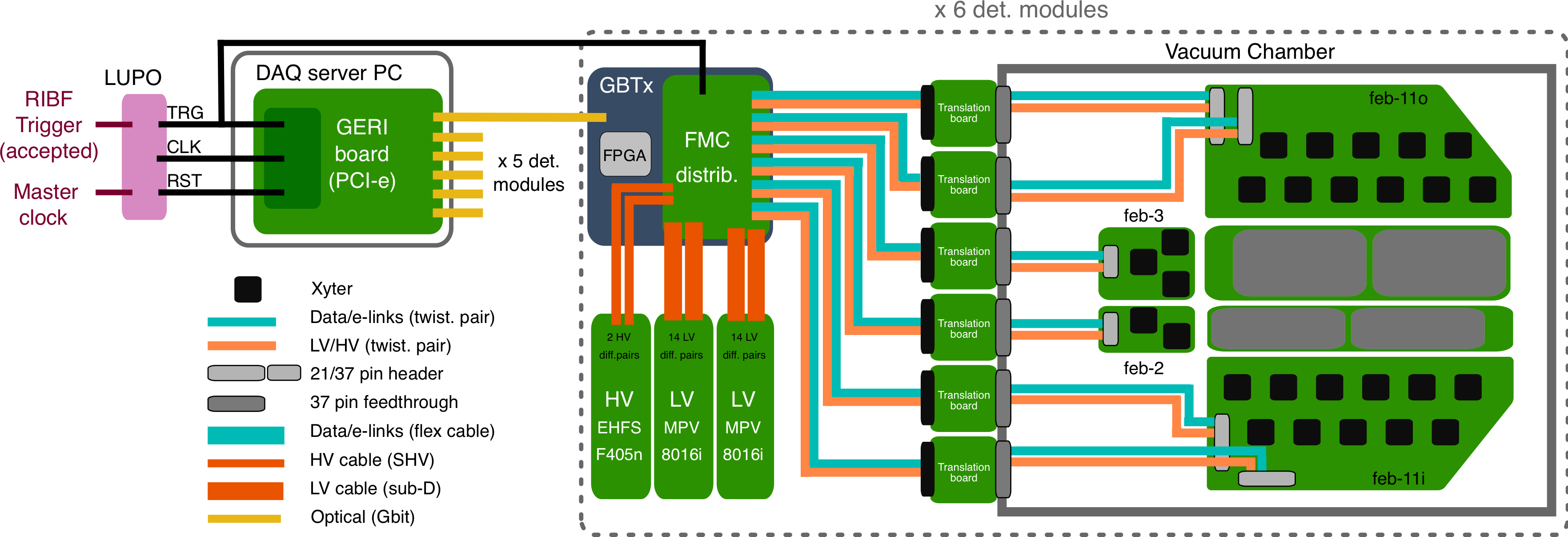
Figure: STRASSE electronics overview showing the connection between the DAQ server, GBTxEMU, FEBs, and detector modules.
¶ Overall Flow
- Silicon Sensors detect recoil protons and generate signals.
- Microcables transmit signals to FEBs.
- FEBs (with STS-XYTER ASICs) amplify, digitize, and timestamp the signals.
- FMC mezzanine: passively distribute signals
--> LV, HVs to chamber for FEBs
--> RIBF Trigger to GBTs (and clock ?) - GBTxEMU Boards aggregate data from FEBs and transmit it via optical fibers.
- GERI Board on the DAQ server synchronizes and records the data.
- Offline Correlation: Data is merged with the RIBF DAQ using timestamps.
¶ Key Components
| Component | Description | Role |
|---|---|---|
| Silicon Sensors | Double-sided strip detectors (DSSDs) with 200 μm (inner) / 300 μm (outer) thickness and 200 μm pitch. | Detect recoil protons with high granularity. |
| STS-XYTER ASIC | 128-channel chip (8 mW/ch) with 5-bit ADC, 14-bit timestamp, and < 10 ns time resolution. | Amplify, digitize, and timestamp signals. |
| Front-End Boards (FEBs) | 4 types: FEB2, FEB3, FEB11i, FEB11o. Host STS-XYTER ASICs and connect to microcables. | Read out signals from silicon strips. |
| Microcables | Ultra-light, low-capacitance Al-polyimide cables (developed by LTU Kharkiv). | Transmit signals from sensors to FEBs. |
| GBTxEMU Boards | Aggregate data from FEBs and transmit via optical fibers to the DAQ server. | Data concentration and synchronization. |
| GERI Board | Hosted on the DAQ server, synchronizes data from all GBTxEMU boards. | Merge data streams from all modules. |
¶ Performance Requirements
| Requirement | Target | Achieved |
|---|---|---|
| ENC (Equivalent Noise Charge) | < 10 keV | ~4–5 keV (with 200 μm Si) |
| Dynamic Range | 2–132 fC | 0–15 fC (high-gain) / 0–100 fC (low-gain) |
| Dead Time | < 100 μs | 0.8 μs |
| Time Resolution | < 10 ns | 3.125 ns (timestamp period) |
| Power Consumption | Minimal | 8 mW/channel |
¶ Challenges and Solutions
| Challenge | Solution |
|---|---|
| Noise Reduction | AC-coupled detectors, low-capacitance microcables (< 50 pF), and optimized STS-XYTER settings. |
| Heat Dissipation | Cooling blades (Cu/Al) and liquid coolant (water at 5°C, 4 L/min). |
| Space Constraints | Compact FEBs placed in dead angles between silicon sensors. |
| Vacuum Compatibility | All electronics operate in vacuum (no active cooling inside chamber). |
| Ground Loops | Star grounding topology to avoid loops. |